Solution / Hardware / TRENPEX RailGate
The OCR gateway for your rail transport
Our TRENPEX RailGate combines OCR (Optical Character Recognition) and OFD (Optical Feature Detection) to reliably and unambiguously recognize and identify features such as lever positions and graffiti, as well as the numbers of incoming and outgoing rail vehicles—including locomotives, trains, and freight cars and containers.
Rail vehicles usually bear a European Vehicle Number (EVN), formerly known as a UIC number (named after the International Union of Railways, the UIC, French "Union Internationale des Chemins de fer") or a number from the Organization for Cooperation between Railways (OSJD).
In closed, private rail networks, such as those used in mining, industrial parks, or ports, there are also vehicles without official number plates. These are assigned their own TRENPEX number, known as the TRENPEX Identification Number (TPID).
Regardless of the type of license plate, our technology automatically recognizes all numbers and uniquely identifies all vehicles.
The cameras in the TRENPEX RailGate on site take pictures of the vehicles. This raw data (frames) is then processed in the downstream image processing (in the TRENPEX DataHub) into high-resolution images for each individual rail vehicle, which you can then view via the TRENPEX portal. Numerous details can be seen, such as lever and valve positions or damage and dirt. As standard, you receive two high-resolution images of each rail vehicle as a side view: one image shows the car in full height, the other shows the bogies. This allows you, for example, to immediately inspect the brake shoe linings or identify the numbers of the carrying cars.
The TRENPEX solution, with its IT infrastructure, is fundamentally designed in such a way that, if necessary, the view from the opposite side of the track and the view from above the rail vehicle can also be integrated. These enhancements to improve recognition performance are always useful or necessary if the numbers on one side are damaged, if you want to check the correct labeling on both sides for hazardous goods transports, or, for example, to defend against claims for damages.
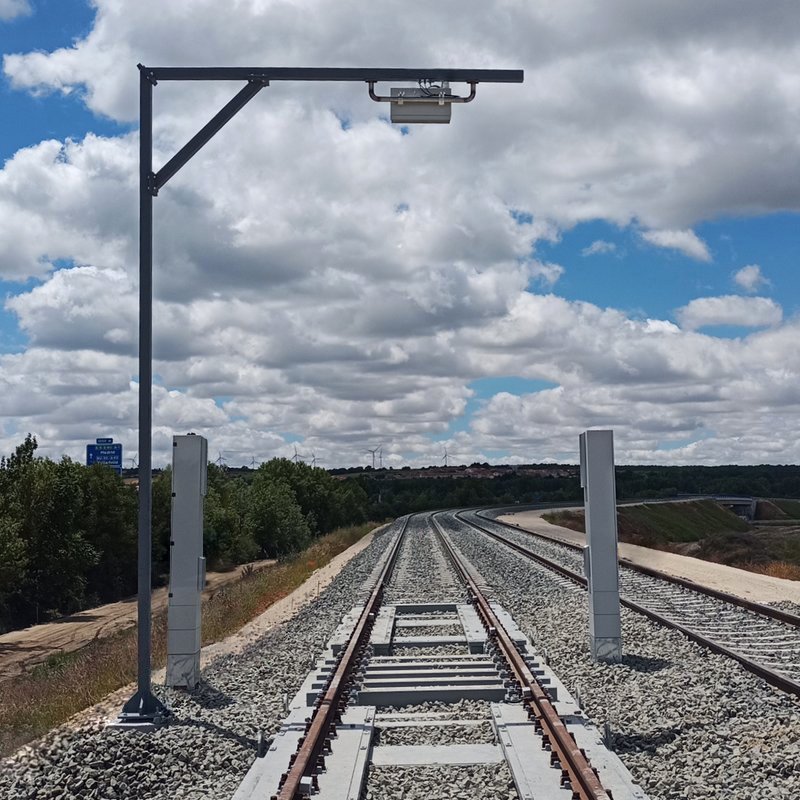
Installation
Space-saving and flexible
The installation does not interfere with the superstructure of the track system, which is why no approval is required.
For the on-site connection, we only need a standard power supply with 110 or 230 volts.
The TRENPEX RailGate requires only a small distance to the track or clearance gauge (60 cm) and can also be installed between adjacent tracks to seamlessly detect rail traffic on neighboring tracks.
If necessary, a switch box can be installed on both sides of the track. If you also need a view from above (for example, to check the fill level or to inspect the cargo), cameras can also be installed above the track so that you can monitor the passing rail vehicles from all angles. Cameras can also be installed above electrified tracks with overhead lines.
Dimensions: 30 x 40 x 250 cm
Power supply: 110 or 230 volts
Distance: 60 cm from the track or wagon
Benefits
Camera system for continuous 24/7 detection of rail vehicles
The hardware with integrated camera is mounted directly outside the clearance profile and requires only a minimal distance from the track, making installation extremely flexible—even between adjacent tracks in the area of a track harp, track field, or track group. Thanks to its close proximity to the side wall of the wagon, there are no temporary obstructions between the camera and the rail vehicles, ensuring uninterrupted image capture. The system is capable of capturing rail vehicles of any length completely, without distortion, and in a single image, regardless of the direction of travel and speed.
Equipped with integrated infrared lighting, the system operates reliably around the clock without the limitations normally associated with white light illumination. The high-resolution images enable precise detection of even the smallest details and damage to rail vehicles and freight, such as screws, brake lever positions, seals, dents, and contamination.
Our proprietary OFD/OCR engines achieve an automatic recognition rate of nearly 100% for all regulatory markings. In addition, the centralized post-processing performed through TRENPEX ensures the complete extraction of relevant information, including EVN numbers, hazardous goods markings, BIC/ILU codes for containers and much more.
| Just an arm's length away from the tracks | |
| Installation between adjacent tracks | |
| No temporary obstacles between the camera and the cars | |
| Unlimited vehicle length | |
| 24-hour operation | |
| No exposure restrictions | |
| High-resolution images (up to 16k) |
Functions
TRENPEX RailGate at a glance
Our OFD/OCR gate records the entire train, including all information on speed, number of axles, total train length, transit time, and direction of travel. You can see the breakdown of the entire train into locomotives, individual wagons, and containers. We automatically perform plausibility checks on the recognized data for vehicle numbers, axle numbers, bogies, and car lengths.
Feature recognition with OFD, for example:
- Container positions (position on the train and distance from the train's locomotive)
- Placards
- Graffiti
- Lever positions (e.g., brake lever)
- Dome cover
Number recognition with OCR, for example:
- EVN numbers (formerly UIC numbers)
- OSJD numbers
- TPID numbers
- Container numbers (BIC code)
- ISO container types
- Hazardous goods identifications: Hazard numbers (formerly Kemler) and UN numbers
- Core data (e.g., holder, load limit grid, and revision)
Central data processing and data management takes place in the TRENPEX DataHub.
We provide you with high-resolution vehicle images and all vehicle information at any time and regardless of location via our user-friendly TRENPEX portal.
FAQ
The most important questions and answers about TRENPEX RailGate
How quickly is the data available on the TRENPEX portal after passing through the TRENPEX RailGate?
The data is usually available within 1 to 2 minutes. Once the measurement event is complete, the data is sent to the TRENPEX DataHub servers, where it is processed and then made available immediately. Data transfer now takes up most of the time. Processing on our servers, on the other hand, takes less than a minute.
How long does it take to install the TRENPEX RailGate on the track? Is it necessary to close the track during installation?
After appropriate preparation, the actual installation and commissioning only takes about half a day. Our installation on connecting railways is usually carried out during ongoing operations without track closures.
Is the top view also possible on an electrified line?
Yes. The only requirement is that the distance to the contact wire must be maintained. In this case, the camera is mounted slightly higher and the optics are adjusted accordingly.
Does the weighbridge have to be located in the same place as the TRENPEX RailGate?
No. Technically speaking, you only need to ensure that the data from the scale matches the train that is visually recorded by our system before or after weighing. You can choose the ideal installation location for both systems.
It is common for the weighing unit to be installed up to 50 meters in front of or behind the TRENPEX RailGate. Of course, automatic weighing still works in both directions of travel.
Do you have any questions?
Chat with your preferred AI assistant or contact our experts to learn more about TRENPEX RailGate and how it can benefit your business.


Looking for a road logistics solution?
Our proven technology is not only suitable for rail. There is also a special solution for trucks and road vehicles that offers the same precision and reliability for intermodal transport.
Explore the TRENPEX RoadGate solution