Author

Dr. Christian Schüller
Co-Founder & Product Tech Lead, TRENPEX
Subscribe to our newsletter
Share
Rail service disruptions rarely begin where their effects become apparent.
In recent weeks, operators on the corridors leading to Germany’s North Sea ports have had to contend with a challenging combination of network bottlenecks, staff shortages, signal disruptions, and pressure on the terminals.[1] The GSM-R outage in Germany in June 2026 dealt another significant blow to a system that was already under strain.[2]
When a train is canceled, a connection is delayed, or—for example—a locomotive is missing, the real challenge for those involved along the transport chain often doesn’t arise until afterward. Containers continue to arrive at the terminal, trucks are waiting at the gate, and shunting activity increases. Decisions must be made even as the original plan has already been overtaken by reality.
This is precisely where a problem arises that is often underestimated in intermodal transport:
The disruption starts on rail, but the pressure only becomes visible at the terminal.
When Uncertainty Becomes Physical
A delayed status update is an information problem in the office. In a terminal, it becomes a container in the wrong place.
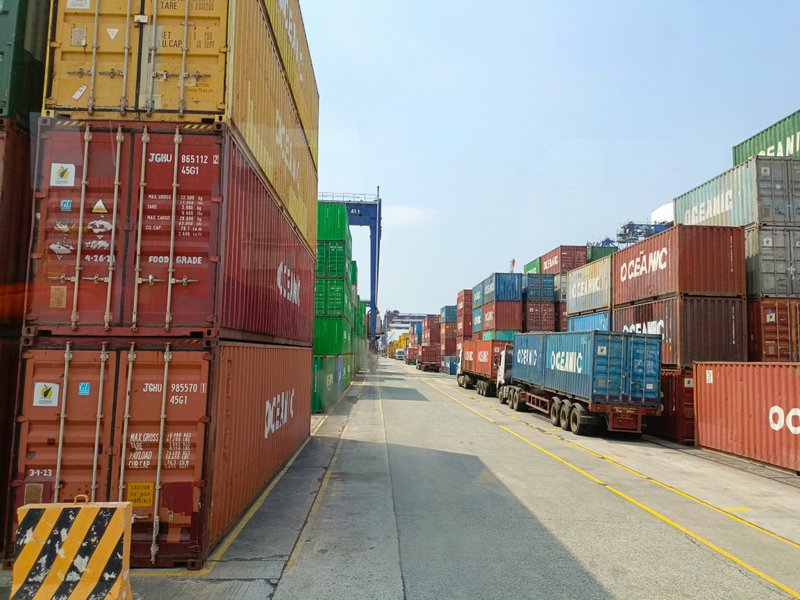
Terminal operations, in particular, are where many individual uncertainties converge. This is because a train cancellation there affects arrival times, storage space, internal movements, truck traffic, and customer communication.
From the outside, a terminal still appears to be operating smoothly. Yet in day-to-day operations, the room for maneuver shrinks with every passing hour. At some point, measures no one likes have to be taken: limiting intake, adjusting time slots, prioritizing shipments, or reducing inflows.
These decisions are often necessary because terminals today are frequently used as a buffer between different modes of transportation, yet they have limited capacity. Storage space, personnel, maneuvering capabilities, and time slots cannot be expanded indefinitely. Therefore, it is essential to identify early on when a disruption in the rail network begins to affect terminal operations.
Furthermore, a bottleneck rarely remains isolated. A 2025 study on multimodal container terminals shows that local disruptions within a terminal can quickly affect other areas. Yard traffic and congestion can lead to delays in other areas and cause containers to pile up.[3]
The schedule alone isn't enough
In intermodal transport, reliability is often measured by the punctuality of trains. Punctuality in rail transport is, of course, important. But it does not account for the entire customer experience in intermodal transport.
The ALICE Intermodal Transport Survey 2025 surveyed 51 stakeholders in the European logistics industry, including shippers, logistics service providers, rail operators, intermodal operators, and infrastructure managers. One finding of the study is that problems often arise outside the actual rail route. First-mile and last-mile processes, terminal operations, and truck scheduling have a significant impact on the customer experience.[4] In my experience, this aligns with many situations encountered in day-to-day operations.
A train delay can be the trigger. The consequences arise later: The freight forwarder is working with outdated information, so the truck departs for its destination at the originally scheduled time. The terminal prepares for a departure that may no longer take place as planned.
Each individual step can be understood. Together, they create a problem.
A shared view before overload
Disruptions cannot be completely avoided. Therefore, a transportation network must, by its very nature, be able to adapt to changes in order to be resilient. To achieve this, an intermodal corridor needs, above all, a shared understanding of the current situation. The key questions are often very specific:
- Which containers are already at the terminal?
- Which ones are still on their way?
- Which train routes are at risk?
- Which areas of the yard are approaching their capacity limits?
- What are the priorities?
- Which customers need to be notified early on?
Research on disruption management in intermodal freight transport shows that real-time data can help respond more quickly to changes. Hrušovský et al. describe an approach that combines existing planning with ongoing replanning based on current event data.[5] This is a very practical approach, because the benefit lies not in predicting every disruption, but in identifying the affected transport units early enough to make even better decisions.
From Reacting to Taking Action
The European research project ReMuNet took a similar approach. It focused on identifying disruptions, their impact on multimodal corridors, and the provision of alternative transportation options based on up-to-date data.[6]
The study on Adaptive Intermodal Transportation examined another aspect. Among other things, it focused on delay buffers as well as consolidation and deconsolidation strategies for situations with limited capacity.[7] The idea behind this is that shipments must be able to be reassessed in the event of changes. In day-to-day operations, this means that some transport units must wait, others must be rerouted, still others must be processed with priority, and some require a different route.
For such approaches to work, data from actual operations must be available. However, this data is often scattered across different systems and held by different companies. Furthermore, some planning systems are not (yet) capable of processing real-time data, or that data is simply not available at all.
The data is generated at the physical interfaces
Much important information does not originate in the planning system. Instead, it originates where the transport actually takes place:
- A railcar passes through a gate.
- A container arrives on the premises.
- A vehicle is identified.
- A hazardous materials label is detected.
- A weight is determined.
- Brake lever position is matched against the load condition.
If these events are recorded manually, late, or separately from one another, part of the overall picture will be missing later on.
This is where automatic recognition systems come into play. These systems can capture the necessary information directly at physical interfaces, such as the factory gate. OCR and OFD systems recognize vehicles, containers, and relevant characteristics during ongoing operations. Through a central data platform, this information can be linked across locations with ERP, TMS, or TOS systems, thereby contributing to a better overview of the situation in intermodal transport chains.
For TRENPEX, this is precisely where the practical approach lies:
A digital overview doesn\'t start with the dashboard. It starts with reliable events from physical logistics. After all, a level of transparency is only as good as the data that feeds it. If the system doesn\'t know what has arrived, what has already passed through, and what is still pending, every higher-level planning tool is working with an incomplete picture.
Final Thoughts
A terminal should not be the place where all the uncertainties of the transportation chain converge. It should be treated as an active control point in the intermodal chain. This requires reliable tracking of events at the physical interfaces, the exchange of status information along the entire corridor, and contingency plans that are already in place before the terminal reaches capacity.
The next stage in the development of intermodal transportation will come about through a better shared understanding of reality. The key question is:
How early can we tell that a disruption on the tracks will turn into a problem at the terminal?
Sources
[1] Otto Hawlicek, Managing Director of Container Terminals Salzburg and Enns, LinkedIn post on the current situation in intermodal transport along the Salzburg–German North Sea ports corridor, July 2026. The post documents a terminal operator’s observations regarding cancellations of export trains and the resulting operational bottlenecks. Profile
[2] Reuters reported that Deutsche Bahn experienced a nationwide outage related to the GSM-R digital railway radio system in June 2026. The outage affected long-distance, regional, and some commuter rail services. The Rail Journal later reported that DB InfraGO determined the cause to be a GSM-R malfunction on June 23, which paralyzed the network for 2 hours and 20 minutes and led to corrective measures. Sources:
Reuters, “Deutsche Bahn Blames Technical Problem for Nationwide Train Shutdown,” June 24, 2026. Link
Rail Journal, “Software Glitch Caused Nationwide GSM-R Outage in Germany,” 2026. Link
[3] Zhang et al., “Analysis of the Ripple Effects of Disruptions on Multimodal Container Terminal Operations,” Transportation Research Part E, 2025. Link
[4] ALICE, “Intermodal Transport Survey 2025: Unlocking Rail’s Competitive Potential,” European Technology Platform ALICE, published on July 8, 2026. The report is based on 51 responses from stakeholders in the European logistics sector. Link
[5] Hrušovský et al., “Real-time disruption management approach for intermodal freight transport,” Journal of Cleaner Production, 2021. The article proposes a decision-support approach that combines planning with re-planning based on real-time data regarding unexpected events. Link
[6] European Commission, CORDIS, “Resilient Multimodal Freight Transport Network (ReMuNet),” Horizon Europe, project end date: June 30, 2026. The project aimed to identify disruptions, assess their impact on multimodal corridors, and communicate alternative routes to logistics operators. Link
[7] Filom et al., “Adaptive Intermodal Transportation,” Logistics, 2025. The article discusses delay buffers as well as consolidation and deconsolidation strategies for managing disruptions in freight transportation. Link