Authors

Yannick Albrich
Software Security Engineer, TRENPEX
Contributors

Dr. Christian Schüller
Co-Founder & Product Tech Lead, TRENPEX

Angie Zetterberg
Public relations, TRENPEX
Subscribe to our newsletter
Share
Introduction: The growing threat in the cyber world
In today's digital world, companies are more dependent than ever on their IT infrastructure—whether for operating business processes, exchanging data, or communicating with customers. But with this increasing connectivity, the risks are also growing. Cyberattacks are no longer just an issue for large corporations, but now affect companies of all sizes and industries.
The threat landscape has changed dramatically in recent years. Hackers and cybercriminals are developing increasingly sophisticated methods to infiltrate corporate networks, steal sensitive data, or paralyze operations. The figures speak for themselves: in 2023, a cyberattack was recorded every 39 seconds worldwide.¹ For companies, this means that an inadequate cybersecurity strategy can lead not only to financial losses but also to irreparable damage to their reputation.
Accordingly, cybersecurity is no longer an optional luxury, but an urgent necessity. In this article, we show you why it is crucial to proactively address this issue and what specific measures you can take to protect your company from ever-growing threats.
Current threats: What endangers your company?
In recent years, cyber threats have evolved massively and are becoming increasingly complex. Whereas in the past it was mainly viruses and simple hacker attacks, today it is targeted, often highly sophisticated attacks that can bring companies of all sizes to their knees. The threats are diverse and range from data theft and extortion to sabotage.
Phishing: The entry point for many attacks
Phishing remains one of the most common and dangerous methods of attack. Cybercriminals pose as banks or service providers, for example, in order to obtain sensitive information such as passwords or payment details. This type of attack often uses emails or fake websites to deceive the victim. According to a study by Verizon, phishing was involved in almost 20% of all cyberattacks in 2024 and 2025.²
Ransomware: Your data held hostage
Ransomware is a particularly insidious method of attack. Hackers encrypt a company's data and then demand a ransom for decryption. Such an attack can paralyze operations for days or even weeks, resulting in massive financial losses. It becomes particularly dangerous when critical data or customer information is affected. According to a report by the British company Sophos, which specializes in cybersecurity solutions, ransomware attacks were the most commonly used attack vector for the third consecutive year in 2025, accounting for 32% of all attacks.³ The average cost of restoring operations after a successful attack was $1.53 million – not including any ransom payments.³
Data leaks and data theft: A nightmare for data security
Data is a company's most valuable asset. If hackers gain access to sensitive information such as customer or financial data, the consequences can be devastating – from financial damage to irreparable damage to reputation. Companies need to be aware that data theft can occur not only through external attackers, but also through insider threats or inadequately secured systems. In 2025, for example, the healthcare sector experienced a 30% increase in data breaches compared to the previous year.⁴
Denial-of-service (DoS) and distributed denial-of-service (DDoS): Paralyzing operations
In DoS and DDoS attacks, a company's servers are flooded with excessive requests in order to block online services. This causes overload, meaning that services may no longer be accessible to customers or employees. Although these attacks are often less sophisticated than phishing or ransomware, they can still result in significant financial losses—especially for online businesses that depend on their web presence.
Supply chain attacks: Attacks via third parties
An increasingly notable trend is supply chain attacks, in which hackers exploit vulnerabilities in third-party systems to gain access to a company. For example, in 2020, software provider SolarWinds was the target of a massive attack that affected thousands of companies.⁵ As companies increasingly rely on external service providers and partners, this type of attack is becoming more and more dangerous.
Zero-day exploits: Undiscovered vulnerabilities as a point of attack
Zero-day exploits take advantage of unknown security vulnerabilities in software that have not yet been discovered or patched by the manufacturers. This type of attack is particularly difficult to prevent because the flaw is unknown to both the company and the software provider. Once a zero-day exploit is discovered, attackers can penetrate the system unhindered, which can lead to serious damage.
Key ideas
The threats from cyberspace are diverse and constantly evolving. No company, regardless of size, is immune to these attacks. This means that a comprehensive cybersecurity strategy covering all possible attack vectors is essential. In the following chapters, you will learn how to protect your company from these threats and what measures you should take immediately.
Why should you act now? The risks of delaying
Acting quickly is key to protecting your business. Those who neglect or delay cybersecurity in their company not only expose themselves to potential attacks, but also to serious consequences. The risks of hesitation are manifold and affect companies on several levels: from financial damage and legal problems to irreparable damage to reputation.
Financial losses: The direct impact of an attack
Ransomware, data theft, and other forms of cyberattacks have immediate financial implications. While attackers often demand ransom payments, the costs of restoring data, repairing systems, and fixing security vulnerabilities can also be enormous. As described in the previous section, restoring operational capability after a successful ransomware attack in 2025 cost an average of $1.53 million—not including ransom payments.
Companies may also suffer additional financial damage as a result of the suspension of business activities. However, confidence in the company may also decline significantly, which in turn leads to further losses of revenue.
Legal consequences and liability
In many countries—including the EU with its General Data Protection Regulation (GDPR)—companies are required to protect the data of their customers and employees. A data leak or cyberattack in which personal data is stolen or disclosed can have legal consequences. In addition, high fines for violations of data protection laws can place a burden on the company.
In the healthcare sector, where the protection of sensitive health data is particularly important, data breaches can result in severe penalties. Another risk is that affected customers could take legal action against the company and claim damages.
Loss of reputation: Your customers' trust at stake
One of the greatest long-term dangers of a cyberattack is damage to reputation. Customers, partners, and investors expect their data and the company's systems to be secure. If this trust is shaken by a successful attack, it can permanently damage the company's image.
On average, it takes companies nearly eight months to recover from a loss of trust among customers and partners following an IT security incident.⁶ Some of these customers and partners never return. For companies that rely on data and confidentiality—such as banks, healthcare providers, and online retailers—such a loss of trust can have a catastrophic impact on business relationships.
Growing attackers and sophisticated attack methods
Attackers are constantly finding new ways to infiltrate networks. Zero-day exploits, social engineering, and advanced persistent threats (APT) are just some of the techniques they use today. These attacks are often difficult to detect and even harder to defend against if a company's security infrastructure is not up to date.
In addition, attackers are increasingly relying on supply chain attacks, in which they infiltrate a company via third-party providers or partner companies. Such attacks have increased significantly in recent years. This highlights how important it is to regularly check not only your own IT infrastructure, but also that of your partners and suppliers.
Missed opportunities due to inadequate security strategy
Another often overlooked aspect is the delay in innovation. Companies that view cybersecurity as an obstacle and are negligent in this area could miss out on technological developments that would increase their competitiveness in the long term. Fear of cyber threats can cause companies to shy away from new digital opportunities and innovative technologies because they feel insecure. However, a well-thought-out cybersecurity strategy can pave the way for a secure digital transformation.
Key ideas
The risks of delaying the implementation of cybersecurity measures are considerable. While companies wait for something to happen, the likelihood of a successful attack increases and the potential damage becomes greater. Those who fail to act today may have to face the consequences tomorrow. A proactive cybersecurity strategy is not only a protective measure, but an essential investment in the future of your company.
Concrete measures: How to strengthen cybersecurity in your company
Cybersecurity is not a one-time task, but an ongoing process that requires constant attention and adaptation. To effectively protect your business, you must not only respond to current threats, but also take proactive measures to prevent potential attacks or minimize their impact. Below are some concrete steps you can take immediately to improve your cybersecurity:
Protect your networks: A secure infrastructure is the foundation
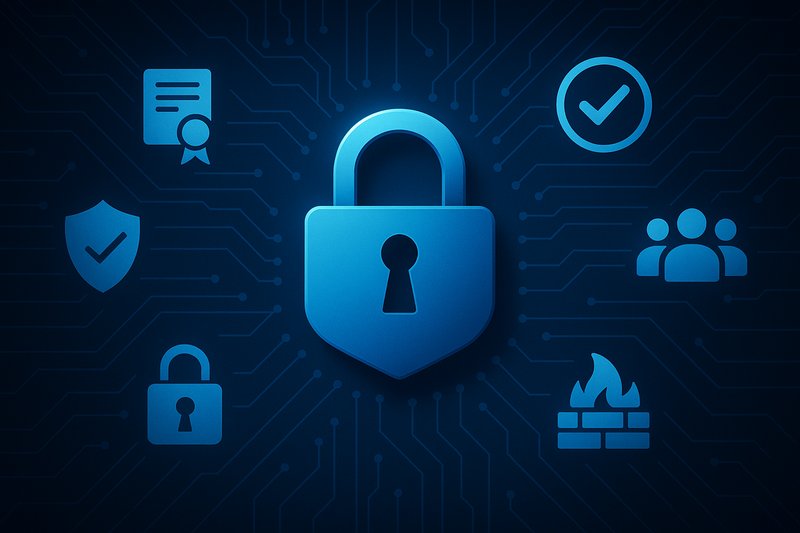
The basis of any cybersecurity strategy is a robust IT infrastructure. Companies should ensure that their networks are protected against unauthorized access. Important measures include:
- Firewalls and intrusion detection systems (IDS): Use a modern firewall that monitors data traffic and blocks potentially harmful connections. Supplement this with an IDS that detects unusual or suspicious activity on the network.
- Encryption: Protect sensitive data with strong encryption, both during transmission and storage. This makes it more difficult for attackers to access critical information, even if they penetrate the network.
- Security patches and updates: Keep all systems, software, and devices up to date! Cybercriminals often exploit known security vulnerabilities in outdated programs. You can close these vulnerabilities by installing regular updates and patches.
Train and raise awareness among employees: The human firewall
Your employees are a target for hackers that should not be underestimated. Phishing attacks and social engineering often target precisely those who are least security-conscious. Continuous training and awareness-raising among your workforce is therefore essential:
- Training and awareness programs: Train your employees regularly on topics such as phishing, secure passwords, and the dangers of malware. These training sessions should be repeated regularly and adapted to new threats.
- Phishing tests: Regular simulated phishing attacks allow you to test and improve your employees' awareness and responsiveness. This enables weaknesses to be identified at an early stage.
- Access controls and authentication: Require your employees to use multi-factor authentication (MFA) – especially for sensitive systems and data. This makes it much more difficult for attackers to gain access to important information – even if they steal passwords.
Access controls and rights management: Minimize access
Not everyone in the company should have access to all data and systems. The principle of "minimum rights assignment" should be strictly adhered to. This ensures that employees can only access the information they need for their work:
- Role-based access controls (RBAC): Implement a system that restricts access to sensitive data and systems based on the role of the respective employee in the company.
- Regular review of user rights: Regularly check that all employees still have the rights required for their current position. Revoke access rights for individuals who have left the company or whose role has changed.
Backups and disaster recovery: Your plan for emergencies
No company is safe from a cyberattack. That's why you should focus not only on prevention, but also on how to quickly get back up and running in the event of an attack. A disaster recovery plan (DRP) is crucial for resuming operations as quickly as possible:
- Regular backups: Ensure that all important data is backed up regularly and automatically—both locally and in the cloud. Also, make sure that the backups are encrypted to protect them from attacks.
- Test your recovery processes: A backup is only as good as its recovery. Therefore, regularly ensure that your data and systems can actually be restored in the event of a failure or attack.
- Business continuity plan (BCP): Create a comprehensive business continuity plan that describes in detail how your company can continue to operate in the event of a serious attack or disaster.
Securing external partners and suppliers: The weak points in your supply chain
In many cases, cyber attackers gain access to corporate networks via suppliers or third-party providers. It is therefore important to secure not only your own infrastructure, but also the partners you work with:
- Supplier assessment and security: Regularly check whether your suppliers and partners have implemented appropriate security practices. Request appropriate evidence of their security measures from them.
- Contracts and security policies: Integrate security requirements into your contracts with partners so that they also comply with your security standards.
Regular security audits and penetration tests: Identify vulnerabilities early on
Security vulnerabilities are inevitable, but they must be identified and remedied early on. To identify potential weaknesses in your system, you should perform regular security audits and penetration tests:
- Penetration tests (pentests) allow you to simulate attacks on your systems and thus uncover vulnerabilities in your security infrastructure. This enables you to close security gaps before a real attacker can exploit them.
- Security audits: Conduct regular audits to ensure that all security policies and procedures are being followed and that there are no gaps that could be exploited by attackers.
Key ideas
Cybersecurity is not a one-time project, but an ongoing process. Keeping pace with the ever-evolving threat landscape requires regular adjustments and a proactive approach. The measures mentioned above are just the beginning: continuous monitoring, training, and the implementation of new technologies will help you protect your business in the long term.
The role of an emergency plan: How to prepare for an emergency
Any company can be hit by a cyberattack at any time. Without a clear emergency plan, you risk uncoordinated responses, prolonged downtime, and significant damage. Below, you will learn how to prepare for an emergency.
Why an emergency plan is important
An emergency plan helps your company respond quickly and efficiently to a cyber incident. It minimizes downtime, protects your data, and ensures that you comply with legal requirements. Without such a plan, you will be unable to act in times of crisis.
Key components of an emergency plan
- Risk assessment: Identify potential threats and their impact on your business.
- Emergency team: Designate a team with clear tasks and responsibilities.
- Communication: Determine how you will inform employees, customers, and partners in the event of a crisis.
- Incident Response Plan: Document how the team should respond in the event of an attack—from isolating affected systems to working with experts.
Practice makes perfect
An emergency plan is only effective if it is tested regularly. Therefore, conduct tabletop exercises and penetration tests to ensure that your team is prepared for real threats.
Rapid recovery
In addition to responding to the incident, rapid recovery is also crucial. Therefore, ensure that regular backups are made and that your most important systems are quickly back online.
Key ideas
An emergency plan is not a "nice-to-have" measure, but a necessity. If you create a clear plan today and test it regularly, you can react quickly in an emergency and minimize damage.
Conclusion: Cybersecurity is an investment in the future of your company
Cybersecurity is more than just a shield against threats: it is a strategic investment in the future of your company. In an increasingly digitalized world, secure data and systems are the cornerstones of trust and success. Companies that invest in their security infrastructure today not only protect their assets and customers, but also ensure their long-term competitiveness. While minimizing risks, you are also laying the foundation for future growth and innovation. Delays in cybersecurity, on the other hand, can lead not only to financial losses, but also to damage to reputation and loss of trust. Those who act in a timely manner remain on the safe side and are prepared for the digital future.
References
¹See. https://www.watchguard.com/de/wgrd-news/blog/im-jahr-2023-gab-es-alle-39-sekunden-einen-cyberangriff
³See. https://assets.sophos.com/X24WTUEQ/at/9brgj5n44hqvgsp5f5bqcps/sophos-state-of-ransomware-2025.pdf